21.11.07

Market Focus: Technology -- The Simple Truth about Complex Manufacturing

Tech firms need CRM as much as any other company--and sometimes even more.

by Marshall Lager

There's a long-standing (and wrong-headed) belief that CRM technology can be a cure-all for a company's operational woes. There's an equally long-standing (and equally wrong-headed) perception that high-tech manufacturers and vendors don't need CRM. Not only is the 360-degree view of customers, partners, and processes important in the technology vertical; it's made tricky by the complexity of the business models and by the roots of those misperceptions.

In the first place, every business needs CRM, even if only to manage customers' account histories and communications -- CRM grew from contact management, after all. Why, then, the idea that tech businesses don't need it? "It's not as much a process vertical [as] financial services," says Tim Hickernell, senior research analyst, applications, Info-Tech Research Group. The focus is on the products themselves -- and since tech salespeople are often former engineers, they're less likely to be relationship-driven.

This is a dangerous reduction of the situation. Even in the tech world, says Diane Albano, vice president of Americas operations at Progress Software, "People are still selling to people, trying to solve a problem." Progress promotes sales effectiveness of businesses across many verticals, and Albano says the key is communicating. "If you can get that message across to your team, you'll have happier customers and more motivated workers."

Using and contributing to the CRM system, remembering that business is about the customer and not the product, are basic elements that haven't become as ingrained among tech firms as they have elsewhere. Fortunately, fixing issues around adoption and technique among techies requires largely the same effort as it does in other verticals. "You must make it mandatory -- it's not up for debate. But do it in a gentle, prodding way, not with yelling," Albano says. "Show how you're enabling salespeople in order to make them understand why it's necessary."

Beyond adoption, Hickernell notes where tech companies are different from others in terms of CRM. "Selecting the right CRM components is more important," he says. "Channel management and knowledge management are important considerations. There's a very complex value chain -- relationships are at least B2B2C," he says, and often reflexive, where two manufacturers sell each other their products. "Work is spread across the value chain, involving original equipment manufacturers, original design manufacturers, and even different divisions of a single company selling to itself as an internal customer." This means careful tracking of channels, and a firm grasp on information at all stages with knowledge management.

This becomes apparent in engineering-to-order processes. "We maintain virtually no finished goods in stock. Almost all orders we take require engineers to be involved before production begins," says Phil Shields, senior analyst at K&L Microwave, a manufacturer that uses CRM software from IFS. "They may be involved in the quoting process, determining if we can even build a product to the customer's specs, providing technical data or preliminary drawings. After we receive an order, engineers will design the new product; even for repeat orders, engineers many times need to check the documentation provided by the customer to make sure there are no changes since the last time."

Prior to implementing sales-and-marketing functionality, K&L was generating quotes with the IFS ERP system. "This required us to create a customer, sales part, and inventory part just to create a quote," Shields says. "Integration with our ERP system was one of the big reasons we selected IFS's CRM system." Requiring zero programming or customization, all customers, sales parts, customer orders, and invoices are now available within the CRM system. "The IFS CRM system has given us one place to put information, both customer-furnished and K&L documents, so that everyone in the company can access it," Shields says.

Knowledge management and dissemination also comes into its own in high technology. "The expectation for self-service, especially Web self-service, is much higher in this vertical," Hickernell says. "The customer is much more savvy, and more is expected of the vendor. If an error message is programmed into a piece of technology, the customer expects there to be a knowledgebase article for dealing with it."

CRM Remains a Fertile Market

New research points to explosive growth in CRM adoption across every segment -- especially on-demand CRM.

by Demir Barlas

Forty-two percent of U.S. companies are using CRM, according to new market research from the consulting firm KensingtonHouse, and the percentage just keeps on growing. Even more notable, in terms of current and future growth, is the fact that CRM's "market fertility" -- the percentage of companies deploying, upgrading, or actively considering a CRM purchase -- stands at 38 percent, according to the report.

The market-fertility figure is the metric KensingtonHouse chose to highlight, as it reveals a record number of companies deploying or planning to deploy CRM. "This is significantly above what I've seen historically, which has been 18 to 25 percent fertility," says Thomas Moriarty, the consultancy's president.

According to the survey, the main reason for the current wave of CRM popularity is the maturity of the on-demand delivery model and functionality set. Fifty-five percent of respondents expressed a preference for on-demand, with a mere 14 percent nominating on-premise and 31 percent undecided. Eighty-seven percent of survey respondents were either small or midsize businesses (SMBs), but Moriarty says that the preference for on demand extended to the enterprise segment as well. The research, sponsored by Microsoft CRM partner T.H.G. Sales Automation, canvassed 437 respondents representing a population of 20,000 companies with a degree of accuracy of plus or minus 5 percent.

On demand is succeeding because of both its low cost and its simplicity, Moriarty says, adding that KensingtonHouse estimates the model can lower the cost of a CRM deployment by as much as 60 percent while also offering an increasingly user-friendly experience. "Customization is so easy now that you don't have to be a bits-and-bytes guy to go in and create all kinds of different fields, reports, and dashboards," he says.

While on-demand initiatives may be easier to implement than on-premise ones, adopters of either variety should still be aware of the significant risks of project failure. Gartner recently predicted that, by the end of 2008, "25 percent of CRM projects will be postponed or canceled because of the CRM skill shortage in consultants and systems integrators." While this sounds like an inordinately high number to industry outsiders, Moriarty emphasizes that it has to be taken in context. "Three years ago, that number would have been 75 percent," he claims.

The good news is not only that the ecosystem of CRM consultants and systems integrators has matured through continued CRM implementation success, but also that CRM adopters can control their own fates by making CRM an institutional priority. The recent Management Tools and Trends 2007 report from management consultancy Bain & Co. revealed that companies that put more effort into CRM up front (including long-term planning, unwavering executive sponsorship, and diligent change management) get more out of the technology. In the Bain survey, those companies who put a "major effort" into CRM reported a 4.17 satisfaction score on a five-point scale, while those putting in a "limited effort" were only able to achieve a 3.53 score.

That data point alone should convince any CRM adopter aiming to maximize return on investment to enter into the implementation prepared and willing to put in some heavy lifting. "You have to maintain the quality of data and make sure to load a good set of business rules that specify how the system is going to be used," Moriarty counsels. "You have to do the work."


12.11.07

Best Practices in Campaign Management: Tips & Tricks

by Salesforce.com Marketing Blog
Now that we’ve covered the basics of how campaign management works in Salesforce how do you get the most bang for your buck? Here are some suggestions to get you started:

Naming Conventions.
A must-have for any organization running a lot of campaigns. The campaign name is what appears in search so you want it to be unique and easy to identify. Campaign names should be structured in a consistent manner so they are easy to decipher by people outside of marketing. For example: Program - Tactic - Audience - Quarter

Add custom fields to campaigns that align to key metrics.
You may want to know how your programs perform by offer or by tactic (email, web promo, etc). Add these as custom fields to your campaign so you can report on them later. If these metrics are key to decision making in your organization be sure to make them required fields.

Use the active flag on campaigns with purpose.
There are 2 reasons why campaigns need to be active. The first reason, is so you can run the super secret “Campaign Call Down” report. The second reason is so your sales team can find the campaign name from the lookup on leads and contacts and manually add the campaign to the campaign history. If you have thousands of active campaigns, this look-up view for your sales reps gets pretty muddy and decreases the likely hood they will use it, so try and keep your active flags up to date. (Tip: In the Winter ‘08 release you will be able to run the campaign call down report on both active and inactive campaigns removing the necessity to have campaigns active for reporting purposes only)

Create a section on your campaigns for follow up.
This is a great way to communicate to your sales reps or inside sales teams what the appropriate follow up is for each particular campaign. This section could contain key messages, any email templates that should be used for follow up, etc. This way an inside sales person can simply click in to the campaign, and easily identify what their next steps should be.


Standardize your member status values.
Reporting across campaign membership can be difficult without consistency. Maintaining standard values will allow you to compare the performance of your programs against each other. Some example status values are:
  • For web promotions set the default value to “Responded”
  • For events and webinars set the default value to “Registered” with additional values for “Registered – attended” and “Cancelled”.
  • For email marketing set the default value to “Responded”

If you don’t have it already, install the “Campaign Membership” web link from AppExchange. This web-integration link on the campaign detail page pulls up the “Campaign Call Down report I referred to earlier and allows you to see all of the campaign members (both leads and contacts) in one report. If you don’t have this already, install the link off the AppExchange here:

https://www.salesforce.com/appexchange/detail_overview.jsp?NavCode__c=&id=a0330000000j5OdAAI


26.10.07

13 Reasons People Will Open Your Direct Mail

by Jessica Tsai

DMA07: At the Direct Marketing Association's annual conference, the secrets to reaching consumers in the real world.

CHICAGO -- No matter how quickly technology is pushing us toward a digital world, marketers continue to actively rely on direct mail. In fact, advertising spend on direct mail is second only to the money spent on television, according to a presentation by Robert Coen of Insider's Report here this week at DMA07, the Direct Marketing Association's annual conference. Customers, too, continue to enjoy receiving mail, according to experts at the conference. One of those experts, Nancy Harhut, managing director of relationship marketing at Hill, Holiday, a Boston-based communications agency, shared with attendees 13 tips for improving your direct mail campaign.

Studies of human psychology have uncovered various ways people act in automatic ways, Harhut told the audience. For instance, she said, if faced with an entryway on the left and right side, most people have a tendency to go right. Similarly, people have learned how to automatically recognize and respond to what they think is junk mail. Therefore by leveraging the reflexive impulses of human behavior, marketers can optimize their direct mail campaigns.

Here are Harhut's 13 tips about those reflexive impulses, how they can affect campaigns, and what you can do about them:

1. People respect authority: Make your mailings look professional, serious, and official -- whether through key phrases such as "important information enclosed," delivery by respected carriers like Western Union or FedEx, or even the use of high-quality envelopes.

2. People respect authority figures: Unsure of what to do, people tend to trust those who seem to know. Have quotes from famous figures endorsing your product, or simply have a famous client's name on the outside of the envelope -- both result in increased response rates.

3. People are naturally curious: Present your campaign in a unique way and customers will be attracted by its original presentation -- and, thus, interested in what's within.

4. People make very deliberate assumptions: The people that Harhut calls "gatekeepers" are those who filter each mailing before it reaches the intended recipient. They, like most people, can immediately recognize what seems to be junk mail. Marketers have to get past that barrier to entry by appearing important and relevant.
  • Make the mailing personalized.
  • If the mailing is a fulfillment request, be sure to note that clearly on the envelope.
  • Have an official-sounding sender or title, such as "Doctor John Smith," or even "From the
  • Office of the Director of Marketing."
5. People are inclined to touch things.

6. People are drawn to attractive keywords: The most enticing word to consumers is "free." Other words that make consumers feel like they're being introduced to something new include "introducing," "announcing," "finally," "now," etc.

7. When people say "no," it can really mean "tell me more": People often reject an offer because it doesn't solve their problems, but if after they say "no" you come back with a different approach, they may become interested.

8. People respond to compliance triggers: People have been trained to view certain things as signifying an automatic "yes," Harhut says. Coupons are often understood to provide savings whether or not the amount saved is specified. People like to understand why they are being asked to do something, but they don't always bother to listen to what comes after the word "because." Studies have shown that by simply hearing "because" after a request is often enough to stimulate a "yes," she says.

9. People are most interested in themselves: Present your campaign in terms of how the customer will benefit, not in terms of how you are helping them:

  • Tell them how to succeed.
  • Present them with an offer.
  • Flatter them.
  • Deliver good news.
  • Make them feel superior.
  • Tell them something that seems as if it were exclusively meant for them.

10. People make decisions based on both rational and emotional reasons: Appeal to the emotional and they may justify it with the rationality of your offer. They are also more likely to respond when trying to avoid pain, and the nuance is critical; as an example, "Are you losing customers?" is more effective than "Are you getting enough customers?"

11. People feel obligated: Give people a complimentary gift along with the message and many will feel obliged to give something in return.

12. People want what they can't have: People are often charged into action when they think something is "for a limited-time only," "expires soon," or is for just "the first 1,000 customers." In fact, when a limit is imposed on an offer, customers who were already inclined to buy are often compelled to buy more.

13. People do what people who are like them do: People are more likely to think they're missing out than revel in the fact that they are the maverick. Along with a campaign, present an extensive list of customers who have aligned with your company. Regardless of whether those clients are influential individually, the sheer volume can be enough to be convincing.

Honda chooses services model for database

by Ben Woodhead

HONDA Australia's motorcycle and outboard motor business will introduce its first fully fledged customer relationship management system under a contract with Salesforce.com.

The hosted system will replace Honda Australia Motorcycles and Power Equipment's existing Lotus Notes customer database and will be integrated with other technology such as its voice over internet protocol phone system.

The unit's IT manager, Craig Bassett, said the $350 million a year concern would install Salesforce for 40 users in December and eventually increase the number using the platform to 50.

"The major reason for looking at Salesforce was to be able to understand our customers better," Mr Bassett said.

"We had disparate, decentralised databases of customer information all over the company and Salesforce is an opportunity to centralise that.

"We'll be better able to serve our customers and market to them. There's no point trying to market an off-road mini-bike to a 60-year-old.

"We want to understand what a customer may be interested in depending on age, where they live, what their interests are, and we haven't be able to do that."

Mr Bassett said the unit looked at a number of customer relationship management alternatives over the past two years and it had not started out with a clear preference for either a hosted or on-premises system.

However, he said, many big-name vendors quickly priced themselves out of the equation and that a hosted system offered the best value for money.

"When we did a matrix of the costs involved in in-house versus outsourced system, Salesforce came out on top," he said.

"Not in all areas, but in most."

The unit awarded Salesforce. com the contract in July and has been working through requirements testing and proofs of concept for the past two months ahead of the December production rollout.

Integrator Sqware Peg is handling installation of the system.

''Everything Will Be Digital,'' Says Microsoft CEO

by Jessica Tsai

The Association of National Advertisers' "Masters of Marketing" Conference reveals insights about how to handle the industry's future: brand focus and maverick creativity will light the way.

PHOENIX -- The overall theme of this year's Association of National Advertisers (ANA) conference, bringing together 1,200 marketers and advertisers, centered on transformation. In the Web 2.0 era, technological advancements have forced the role of the marketer to change -- fast. One presenter after another regaled the audience with examples of how, with each new development, consumers have been ready for the next innovation and what they've come to expect from marketing -- and marketers.

In the conference's first session, Microsoft Chief Executive Officer Steve Ballmer envisioned a future in which, while watching the PGA championship game, he could communicate to his colleague, Microsoft founder Bill Gates simply by saying to the TV, "Hey, Bill, did you see that shot?" Voice recognition technology would pick that message up, GPS would locate Gates, and the Internet telephony wired into the system would connect a call and convey Ballmer's message. Bill would then respond, "Yeah, and did you notice it was a Nike ball?" Gates's reponse would trigger an interactive shopping interface to pop up on both their screens, allowing either of them, in real time, to purchase a set of similar golf balls through the TV.

Soon, according to Ballmer, "everything will be digital," and, in that world, there is no limit to innovation. Technology will provide boundless possibilities and the only thing marketers need to focus on is human talent. Customer insight will be bursting at the seams -- and the more marketers understand about manipulating that information, the more targeted, relevant, and effective their messages will be.


When technology becomes ubiquitous, the differentiator will be creativity. According to many of the ANA presenters, a strong, innovative, and creative strategy is, and will be, key to the future of brand success. Therefore, companies have to move past the handicap of being "overanalytical," said Bob Lachky, senior vice president of Anheuser-Busch, the St. Louis-based maker of Budweiser and other beers. "At some point you just have to go, 'Make room for creativity.... Nurture your mavericks.' "

And yet, amid all the changes in delivery media, companies must stay true to their brand, Lachky says. Focus on the meaning of the brand everyday, he told the audience, because if companies can't grasp that core message, marketers certainly can't expect consumers to. "Create your own characters," he added, and don't lose sight of them. For example, when you employ a celebrity to deliver your message, that star "must be subservient to your brand," he said.

Even for corporations with a strong identity, such as McDonald's, it is essential never to forget the premise of the brand. McDonald's has been experiencing a revival of late, with healthier food choices and increased focus on nutritional content, according to Mary Dillon, the company's chief marketing officer. The Oak Brook, Ill.-based fast-food chain currently serves an estimated 52 million customers daily worldwide and recently announced that it expects to surpass analyst predictions for third-quarter earnings (to be released on October 19), according to USAToday.com. But the company has suffered its share of bad times. "We took our eyes off the fries, so to speak," Dillon said, adding that the company had failed to execute on the basics, such as customer service, that were essential to the McDonald's brand.

Companies that have stayed true to their brand include Milwaukee-based motorcycle retailer Harley-Davidson, said Chuck Brymer, chief executive officer of DDB, a New York City-based advertising agency. The Harley-Davidson brand embodies the concept of personal freedom -- and by staying true to that central concept, the company has developed a following that "lives and breathes Harley," Brymer told the ANA audience.

16.10.07

Ten strategic technologies to watch in 2008

By Linda Tucci

Protecting the environment has become part of IT's job. Managing your organisation's metadata should be high on the IT agenda. But the Web -- and the new computing models it's spawned -- looms large on Gartner's list of 10 strategic technologies for 2008.

Strategic technologies, as defined by Gartner, are technologies that could disrupt IT or business in the next 18 to 36 months. They may require a large dollar investment and could cripple your organisation if adopted too late. In other words, these technologies carry a high potential to shake up your job, big time. Here's what should be on your radar now, with comments from Gartner analyst Carl Claunch:

Green IT. Here to stay. Regulations are multiplying and could constrain plans to build new data centres. Learn about potential compliance regulations and form an alternate strategy for adding data centres. Don't get on the wrong side of the boss, shareholders or marketing.

Many companies, from Dell to Sole Technology, a small maker of skateboard footwear, are touting Green IT as a component of the company mission. Make no mistake, the software that schedules which applications should run where will and must factor in server energy efficiency. In the meantime: "When you are at a peak period and using everything, you have no choice. During the times when you are not totally maxed out, turn off the ones that are the worst energy hogs," Claunch said.

Unified communications. Twenty percent of companies that used to rely on private branch exchange (PBX) have migrated to IP telephony. But the times, they are a'changin'.

More than 80% of companies are doing trials of IP telephony. In three years, a majority of companies will be using it, Gartner predicts. And no wonder, when even things like video security cameras have become digital, Claunch said. This is the first major change in voice communications since the digital PBX and cellular phone changes in the 1970s and 1980s.

Business process modelling. The imperative for 2008 for this perennial list maker is to bring enterprise architects, senior developers, process architects and process analysts together to jointly define top-level process services. The modelling goal is faster and highly flexible processes. Think Legos. If the business decides it wants to change how it charges for products for two months, IT should be able to get into the process, change it and change it back when required, Claunch said.

Metadata management. A jargon-rich discipline (or lack of discipline, unfortunately) that nonetheless is a critical technology going forward. "If your aim is to have the ability to re-hook the IT systems to rapidly support any change your business might make, then you're talking about connections you don't know in advance," Claunch said. You need clean and consistent data to do that. "Metadata management is part of the magic sauce to that."

Virtualisation 2.0. "This is a change in people's recognition of the scope of what virtualisation can do," Claunch said. Virtualisation is not just about shedding servers -- disaster recovery is a good example. Suddenly, putting in 10 backup machines for 10 production machines is a crude and expensive strategy.

Also just emerging, courtesy of virtualisation: A new distribution model for applications. "Instead of selling and shipping just the application to you, the software supplier might send you a virtual machine file that has everything, the OS and the application, pre-integrated," Claunch said. So less work for you, and the vendor doesn't have to test all the combinations. Cautions? Licensing issues have to be sorted out before pre-integrated applications become widespread. And you'll have to run herd on vendors to make sure patches are updated.

Mashup and composite applications. Web mashups will be the dominant model (80%) for creating composite enterprise applications by 2010. Why? They allow you to rapidly tailor the functionality you want in one place, without having to re-create the original, Claunch said.

Mashups will replace internal portals for employees, who now have to flip between applications to get what they need. Businesses will use mashups to talk to customers about their orders. "You get the tracking information from FedEx, the map from Google, stick in on the same page with your data and now what the customer sees is a picture of a little plane with her order," Claunch said. And the licensing issues here? "Once you make a service that is available and open and doesn't require registration, I think it will be difficult to talk about terms and conditions that are hidden in a contract five screens down."

Web platform and Web-oriented architecture (WOA). Forget the acronym, Claunch said. The idea is this: Software as a Service (SaaS) is forcing companies to evaluate where service-based delivery will add value from 2008 to 2010. Meanwhile, emerging Web platforms are offering service-based access to infrastructure, information, applications and business processes through Web-based "cloud computing" environments. Now is the time to look beyond SaaS and examine how Web platforms will change their business in three to five years.

Computing fabric. Five years ago, you bought a server. Inside there was one motherboard with a particular number of processors, some amount of memory and I/O connections. You got the mix the vendor built. You needed tons of memory and not much processor? Too bad. Blade servers helped. The next step in this progression, Gartner says, treats memory, processors and I/O cards as components in a pool, combining and recombining them into particular arrangements to suits the owner's needs. "You use the fabric to hook them anyway you want," Claunch said. "That's really a revolution."

For example, a large server can be created by combining 32 processors and a number of memory modules from the pool, operating together over the fabric to appear to an operating system as a single fixed server. The enabling technology is the switch that got fast enough to make it feasible. "It's things like InfiniBand" that make it possible, Claunch said.

Real World Web. The Real World Web delivers augmented reality as opposed to virtual reality, in real time, not before or after the fact. It gives tripping a whole new meaning. So, the GPS navigation unit, for example, gives real-time directions that react to events and movements. Now is the time to look for how to cash in on augmenting the world at the right time, place or situation.

Social software. The Web version of mob mentality, the collective conscious, "the wisdom of crowds" -- whatever you want to call it -- is coming to a workplace near you. Web 2.0 products such as wikis, RSS feeds and tagging will be used to communicate and foster collaboration in your company. Expect a shakeout as vendors big, small and just-born strive to deliver robust Web 2.0 offerings to business.

2.10.07

CRM's Future Will Look Nothing Like Its Past

At the Gartner CRM Summit, a distinguished industry analyst outlines (yet again) how companies have learned about -- but continue to struggle with -- the requirements of CRM.

by Colin Beasty

HOLLYWOOD, FLA. -- The CRM marketplace continues to benefit from a stronger economy and renewed attention to driving profitability -- and now, more than ever, chief executive officers are taking note, according to a leading industry analyst. As part of Gartner's annual CRM Summit here yesterday, that was the crux of the message from Scott Nelson, a vice president and distinguished analyst at the firm.

Citing recent Gartner research, Nelson said during his keynote presentation, "Why the Future of CRM Will Look Very Different from the Past," that 72 percent of CEOs stated that building better relationships with customers was the best way to increase revenue. "CRM is the result of the environment a company is operating in," he told the audience. "And thanks to the lessons learned from the past, most businesses' CRM practices are better because of it."

According to Nelson, whose speech had the familiar bent of past Summits, most businesses today have learned to focus their CRM initiatives in order to:
  • increase revenue;
  • cut costs;
  • drive brand awareness; and
  • improve customer loyalty.

Most businesses have learned--but not all, apparently. "I remember one financial services company that had spent close to $1 billion on their CRM project over the course of nearly a decade," Nelson said. "And they still hadn't determined which of these four areas they wanted to address first and foremost." (The arena most companies focus their CRM projects on, Nelson said, is in improving customer loyalty.)

Even as companies gain a better understanding of CRM and expand their expertise, many still have long way to go with their CRM initiatives, Nelson said. Some are still plagued by the problems that have bedeviled the market for years -- including an overabundance of options. "The [vendor] market is still a highly fragmented one," Nelson said, "and organizations are still struggling with many of the strategies and concepts."

But any company still disillusioned by failed CRM efforts had better get past them, Nelson said. Customers are driving the need for improved CRM strategies because the bar has been raised, thanks largely to well-known, innovative CRM practices. Nelson cited Amazon.com as an example: Consumers value its customization capabilities and now expect that level of personalization with other vendors they deal with. "Our customers use Amazon.com and compare us," Nelson said. "They know someone else can do it, so why can't we?"

However, as many who have tried CRM and failed realize, there are some caveats. "Many businesses are still product-driven organizations, and are struggling with making the transition to becoming a customer-driven organization. You can't just automate the front office without thinking about how it may bog down the back office," Nelson warned. If too much information comes in from different segments throughout an organization, he added, "you can bring the back office to a grinding halt."

To help organizations avoid this and other pitfalls, Nelson offered four principles for a successful customer-centric strategy:

  • Extend the breadth and depth of relationships.
  • Reduce delivery channel costs.
  • Reinforce the brand.
  • Focus on customer value and satisfaction.

Nelson also reiterated Gartner's half-decade-old "Eight Building Blocks of Customer Centricity," each of which, he said, is essential for organizations to have:

  • Customer Vision
  • Customer-Centric Strategies
  • Valued Customer Experience
  • Organizational Collaboration (among staff, partners, and suppliers)
  • Managing Customer Lifecycle Processes
  • Collecting and Distributing the Right Customer Information
  • Technology
  • Defining Internal and External Metrics for Success and Failure

The adoption of these eight building blocks helps determine where a company sits in the CRM maturity model, of which Nelson said there are five stages. The first stage of what Gartner calls its "Customer-Centric Generational Framework" includes companies that have no vision or customer-centric strategies, don't know the customer experience, collect only basic and fragmented information, and have very fragmented technology with weak functionality. These Stage One companies also are hindered by departmental silos and have little to no organizational collaboration or processes.

Most companies, according to Nelson, are right where they were a year ago -- and two years ago: between Stage Two and Stage Three. Companies mired there have initial productivity and visibility into their customer bases; isolated customer-centric strategies initiated from the bottom up; and minimal progress on developing customer-experience strategies. Also, these midlevel firms are noticing the first signs of organizational collaboration, starting to optimize processes for efficiency, launching team-based (and, unfortunately, fragmented) customer-information campaigns, and implementing technology (albeit with limited functionality).

The fifth and most advanced stage in Gartner's guide to customer centricity includes companies that have the following:

  • a value network enabled;
  • a value-based collaboration strategy for mutual benefit;
  • an understanding of a wider scope of the customer experience;
  • shared customer centricity with goal alignment;
  • end-to-end process optimization;
  • shared information and insight beyond the company; and
  • strong technology functionality implemented beyond the company to partners.

To reach that upper echelon of Gartner's customer-centric framework, Nelson told the crowd, it's critical that companies understand the most important aspect of CRM success: "It's about defining the business processes and strategies," he said. "Companies still struggle with their CRM initiatives because they struggle to identify and automate the customer processes, or [they] automate broken ones."

And, in the end, companies also need to understand technology's a proper place in the big picture, Nelson said. "You can do CRM without technology; you just need technology to scale it."

20.9.07

Software-as-a-Service Ups Its Game in New Zealand

by CRM Today

Market Expected to Experience 65% Growth in 2007 and Grow to NZ$64 Million by 2010

Springboard Research, a leading innovator in the IT Market Research industry, today announced the results of its latest research on the Software-as-a-Service (SaaS) market in New Zealand. Increased vendor activity and the inherent appeal of SaaS have been responsible for the market growing 65% in 2007 to NZ$14 million. Together with Australia, New Zealand continued to be the most mature market in the region.

“Organizations in New Zealand have been leading adopters of SaaS in the region,” said Phil Hassey, Australia & New Zealand Country Manager for Springboard Research. “SaaS in many ways is uniquely suited to New Zealand- both from a user and developer perspective. SaaS has the potential to free the user from relying on the local infrastructure and implementation capabilities of the software developer as well as giving New Zealand ISVs easier access to a global playing field” added Mr. Hassey.

Compared with traditional software implementations, the business user is becoming the key influencer and enabler regarding SaaS in New Zealand. As non-IT personnel can easily choose, implement, and use SaaS applications, many business users are pushing forward with SaaS either without the knowledge of the IT department in larger organizations, or in the absence of an IT department in smaller companies.

“The number one reason organizations adopted SaaS was because of ease of use and manageability, which empowers non-IT staff to make their own software decisions based on their business needs, instead of their IT infrastructure,” said Balaka Aggarwal, Senior Market Analyst for Emerging Software for Springboard Research. “In countries like New Zealand where IT staff can be expensive compared to the rest of Asia, as well as in high demand, these benefits combined with zero or low maintenance, quick and easy deployment, and a lower cost of ownership help to make SaaS a more cost effective option for most organizations.”

Buoyed by the success of SaaS, Springboard saw that there has been considerable activity in the local ISV space in New Zealand. While multi-national SaaS pure-plays have been active, local ISVs have also stepped up and are being recognized both in New Zealand and internationally. The emergence of small but focused players like Xero (accounting services) who recently raised $15 million to foray into the international market indicates the increased maturity of local players.

Google Goes Gadget

by James Livesley

Google Australia has just launched its “gadget ads” – interactive ads that can be embedded into web pages, as revealed in B&T Digital Media in July this year.

Google Australia has today launched its “gadget ads” – interactive ads that can be embedded into web pages, as revealed in B&T Digital Media in July this year.

The ads give advertisers the option to add flash, video, and real time feeds to what in the past have been typically static display ads. From today the interactive ads can be used throughout the Google content network.

They can be placed by the existing bidding system, which allows advertisers to bid for a publisher’s site or content theme.

The benefit of the system is that it allows users to interact with advertiser’s content without the users having to actively search or click through to a landing page.

The new ads will be integrated into AdSense, the contextual advertising system for web publishers.

Local companies who already have examples of the gadgets available on users’ iGoogle homepages include Webjet, Selective Car Rentals, STA Australia, Autoweb.com.au, Brisbane on the Web and GlobeNet Travel.To view examples of the ads visit:

www.google.com/adwords/gadgetads

The 2007 Market Awards: Marketing Automation

by Jessica Sebor

This has been the year of the end user in marketing automation.

The Market
This has been the year of the end user in marketing automation. Interfaces are more user-friendly, vendors are following customers to the Web, and solutions are more pain-point focused. Vendors are embracing the importance of keeping customers happy as the market becomes more consolidated--Unica's acquisition of Sane Solutions, for example. Bruce Biegel, senior marketing director at Winterberry Group, says, "Continued consolidation is making end users cautious in selection--creating confusion and slowing adoption." To speed sales, vendors have been focusing on online integration and marketing resource management (MRM) adoption. Sheryl Kingstone, director of enterprise research at Yankee Group, summarizes today's bottom line for the vendors in this space: "They have to differentiate themselves through customer experience."

One to Watch
After two straight years on the leaderboard, SAP fell off the grid a bit. Despite moves last year to grow out marketing applications, the company spent more resources focusing on its strengths in CRM and ERP, and fell short of blossoming into a fully fledged marketing automation vendor. "They are missing some loyalty," says Kingstone, who calls the firm "very much an ERP vendor." However, with a broad customer base, a strong direction, and growing software revenues, SAP may reassert itself in the coming year. Forrester's Vittal says that, as far as marketing automation goes, "this is still relatively new for them."

The Leaders
Aprimo, which Kingstone calls the "leader in MRM," proved itself worthy of this praise in 2007. Comfortably ensconced on the leader board, Aprimo continues to expand its breadth and functionality while staying true to its pure-play marketing roots. The company added an offer management application with the release of Aprimo Marketing 7.6, as well as releasing a software-as-a-service (SaaS) version with Aprimo Marketing Professional Edition. "[By] integrating functions of planning, financials, brand-asset management, analytics, and project management on a powerful EMM platform," says Aimee Roberts, research analyst at Frost & Sullivan, "Aprimo has taken marketing automation to the next level."

Another year deeper into its Fusion development process with its Siebel Systems acquisition, Oracle has shown strong focus on marketing solutions. What was a jumble of two vendors last year is now becoming streamlined into a cohesive vision. In 2007, Oracle has paid special attention to the retail sector, releasing Oracle Retail with help from its Retek and ProfitLogic acquisitions. Although some cite the company's direction as still being hazy, all agree on the high level of the vendor's potential. "It has a strong promise," says Suresh Vittal, senior analyst at Forrester Research. "It's still one of the best marketing applications available that's embedded into a suite."

SAS Institute's strategy of delivering solutions to answer specific problems served the company well this year, positioning the vendor as a clear leader in the category. Coming off its 30th straight year of revenue growth in 2006, SAS revved up its targeted offerings in a number of verticals, such as academics, finance, technology, and manufacturing. Still, Forrester's Vittal acknowledges that SAS has a few kinks to work out. "It's really hard to use," he says. "But it's a great company and they're doing a lot of great work."

After flying from the nest of parent company NCR this year, Teradata has shown that, in terms of marketing automation, it's a baby bird that can really soar. "I think the spin-off is good for them," Kingstone says. Although Teradata will continue to stick to its traditional data-warehousing roots after the separation, high levels of customer satisfaction in marketing automation will likely drive heightened focus on marketing solutions as well. Teradata in the past has been criticized by analysts for being slow-moving to market, and many agree the company will need to be quicker and more aggressive in the future. "They have a lot of customer success," Vittal says, "but they still need to work on their real-time applications."

The Winner
Unica, once again, nabbed the top spot with little contest, achieving the highest scores in all categories. Unica's flagship solution, Affinium, continues to prove a favorite in the marketplace. Frost & Sullivan's Roberts says the suite "integrates Web and customer analytics, campaign management, lead management, and core MRM to meet the growing demands of global marketers." Unica continues to upgrade and build out its suite, this year enhancing Affinium Campaign Collaborate as well as Affinium Plan. Although some analysts note that the vendor is still a bit behind in Web analytics, Unica recently took strides to combat this functionality gap with the release of Affinium NetInsight 7.2 for e-marketers in June. With a near-perfect score of 4.4 in company direction--a score taken even before the summer acquisition of boutique MRM specialist MarketingCentral--it's doubtful that this powerhouse will shrink anytime soon.

Forcing the dream

by Ben Woodhead

SALESFORCE.COM has re-badged the development platform that it hopes will one day rival Microsoft's .Net and Sun's Java as it battles to convince customers that it is more than a CRM software maker.

Salesforce.com chief executive Marc Benioff admitted that many of the company's customers still aren't aware that the one-time sales force automation specialist is branching out into new areas that include its so-called platform-as-a-service offering, which has been renamed Force.com.

Speaking to analysts and media at Salesforce.com's annual Dreamforce event in San Francisco, Mr Benioff said that he believed that the new Force.com brand would finally cut through to customers. ″We need to communicate (with customers) at a high level still that we have an applications strategy,” Mr Benioff said.

″A lot of our customers still only think we have one application.”

Instead, Salesforce.com is attempting to pitch itself as the underlying platform for software as a service (SaaS) using Force.com, the Apex custom language the company recently launched and its long-running third party developer program AppExchange.

A number of big name companies, including computer games developer Electronic Arts, have signed on to use Force.com, which is hosted by Salesforce.com from its two US datacentres.

But Mr Benioff acknowledged there was more work to do. In support of that work, and in response to growing demands from its user base, Salesforce.com today launched Visualforce, a tool that will for the first time allow customers to customise user interfaces. It also unveiled details of the latest release of its core technology, including the addition of two new applications: a content management system know as Salesforce Content and Salesforce Ideas, an application that works as a virtual suggestion box.

PC maker Dell has already deployed Salesforce Ideas and based its decision to relaunch a line of products with Linux installed on feedback collected from customers through its IdeaStorm website. The release bearing the two new applications, Salesforce Winter '08, will be available later this year.

19.9.07

Campaigns to Cash - Campaign Management Workshop - Sept 28 2007 - Register Now!


There are LIMITED spots remaining to attend our exclusive campaign management workshop. Don't miss out!

The workshop will be presented by our team of marketing success managers and will cover all aspects of campaign management within salesforce.com including:

  • Set-Up and Modifications of Campaigns
  • Data Import, Data Segmentation and Target List Creation
  • Campaign ROI Reports and Dashboards
  • Importing and Editing HTML Communication Templates

Date: 28th September 2007

Time: 8:30AM - 4:45PM

Venue: Level 10, 10 Barrack St, Sydney NSW 2000

Included: Training, morning tea, afternoon tea, a lunch voucher from Wellbeing (adjacent to the training centre) and a "Campaigns to Cash" Workshop Manual for all attendees.

The cost for this workshop is $495.00 plus GST.

This workshop will SELLOUT and is available to the first 20 registrants only! We look forward to seeing you there!


Sincerely,


Will Scully-Power


General Manager
agency On-Demand®

http://www.sqwarepeg.com/

17.9.07

Google Apps attack: FUD and loathing in Redmond?

by Liam Tung

Software-as-a-service pundits and analysts have hit back hard at Microsoft's criticisms of Google Apps Premier Edition (GAPE) as backwards-looking and fear-mongering.

"Like [US hockey legend] Wayne Gretzky says: 'Go to where the puck's gonna be, not where it is'," said Doug Farber, Salesforce.com's vice president of operations for Asia Pacific, responding to Microsoft's arguments against the use of GAPE.

"Of course Google will have less rich document processing features, of course it doesn't have tables and footnotes. But that's not hard to do and they will be able to do it in a short time. It's a classic case of going to where the puck was and not where it's going," he told ZDNet Australia.

Google and Salesforce.com have partnered to cheerlead the on-demand message of lower capital expenditure, automatic software upgrades and no contract renewals.

"Google's in the early stages of [the hosted desktop application] initiative but just like we evolved rapidly, Google -- with its horsepower and innovation -- will be capable of making quantum leaps and will get to where Microsoft is faster than Microsoft did," said Farber.

As for Microsoft's criticism that Google launches perpetually "in beta" releases of software, he said: "Everyone knows that it takes at least three releases for Microsoft to get it right. Think of the Xbox, Micosoft's CRM system and Windows."

However, as an enterprise solution, doubt still exists as to whether commercial organisations are willing to adopt an on-demand hosted model.

Jason Polites, technical director at Synetek Systems, an Australian-based hosted provider of e-mail-archiving and contract administration applications, said: "It was odd for Google to partner with Capgemini and move into the enterprise space with that offer. There's resistance at all levels [to software-as-a-service] but we see resistance to SaaS as a platform increasing with the size of the company."

Resistance takes two forms, he said. Users will resist retraining if they are familiar with an existing system like Office, while for organisations there is the issue of losing control over corporate data.

"Really, Google can only overcome this [data control] issue with a commercial agreement. That is, 'Warrant me with use of solution and offer indemnity against any data loss'. But this gets complicated with cross-jurisdictional contracts … At a large business or government level, they need to know the commercial agreement they have can be pursued in litigation and that it has substance," he said.

IBRS analyst Joe Sweeney told ZDNet Australia that Microsoft's 10 reasons for not trusting GAPE miss the point most IT managers should be asking themselves.

"What businesses should be asking is: how much of that old formal stuff is still required? Did we go too far with restricting staff in the past? What are the risks for opening up processes and collaboration and empowering staff to 'do their own thing?'" said Sweeney.

"As an enterprise tool, GAPE lacks important features – especially document management, compliance, and process workflow," Sweeney told ZDNet Australia. While Microsoft criticised GAPE's weaknesses as an enterprise document management solution, Sweeney said Microsoft's assertion that Office is, is "questionable".

"The main problem with Microsoft's response is that it assumes that all of these more formal methodologies are required for all applications, on all clients, all of the time," he said.

"What should alarm IT managers is that few of us have asked the above questions ourselves, nor do we have a framework to engage executive management in the discussion. While a lock-it-down mentality does help to avoid disasters, there is a growing argument that some aspects of work should be less controlled."

14.9.07

Salesforce.com + Facebook = Faceforce

by Dennis Howlett

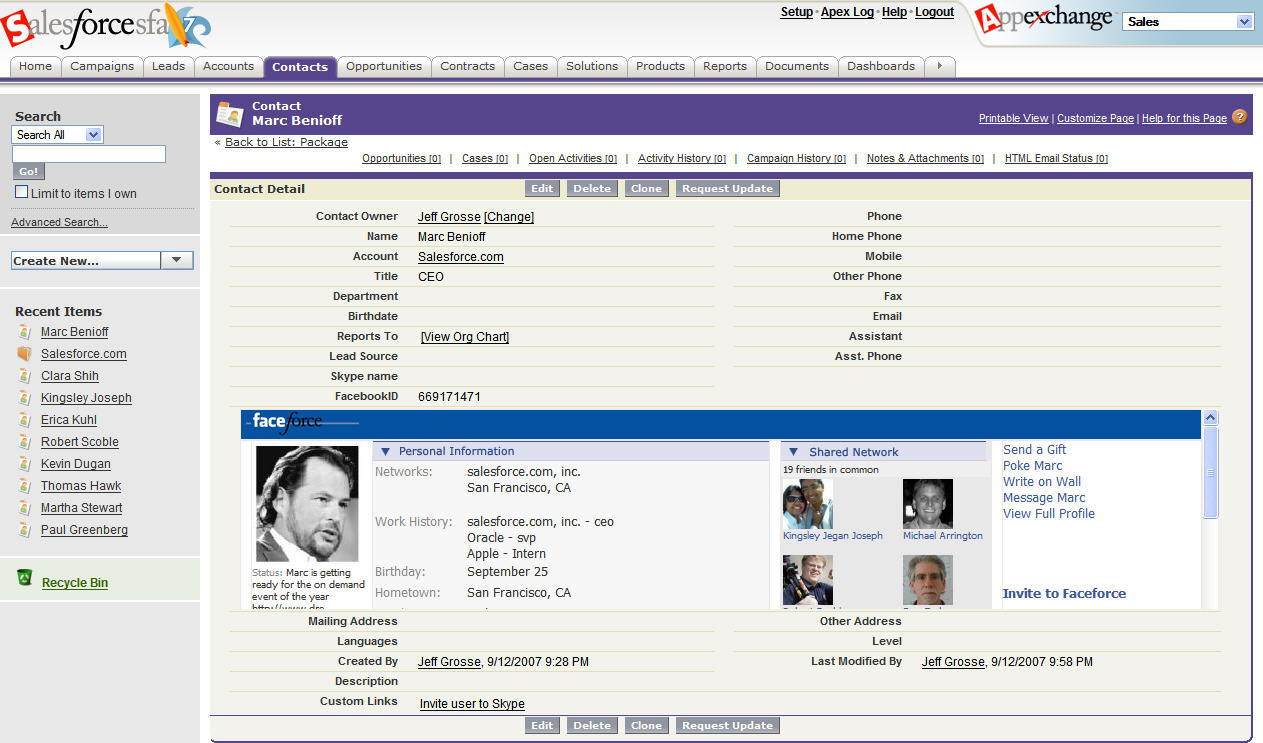
Clara Shih, an AppExchange product manager at Salesforce.com has created a mashup between Salesforce and Facebook called FaceForce. Jeff Grosse has a detailed explanation of what it does at CRM-FYI:


Now in Salesforce, if you look at a Contact that you’re friends with on Facebook, you can see their Facebook profile right inline with their Salesforce contact record. It even allows you to perform regular Facebook actions such as Send a Message, Send a Gift, Write on Wall, Message, view their Full Profile, and even the curious Poke.

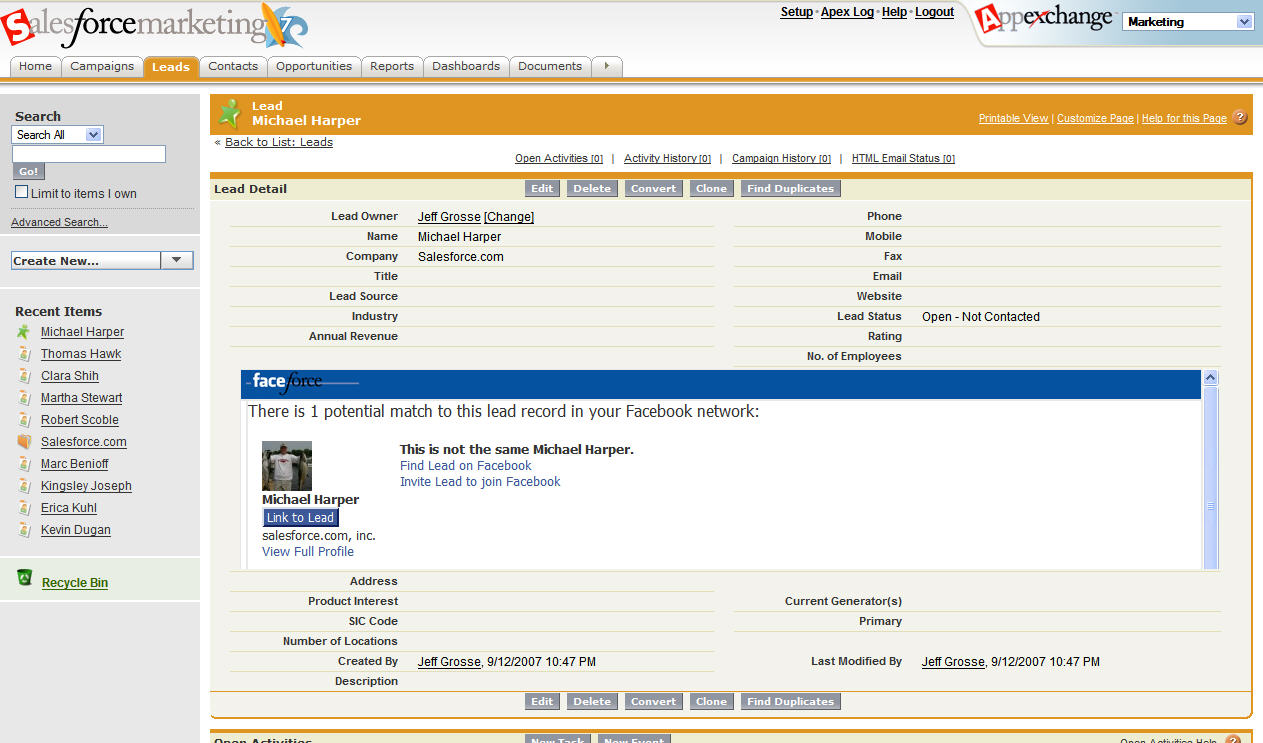
At the Lead level, the S-control will search Facebook for the lead and show possible matches. If that is the person, you can link them to into the lead so you have access to all their Facebook data inline with your lead data.

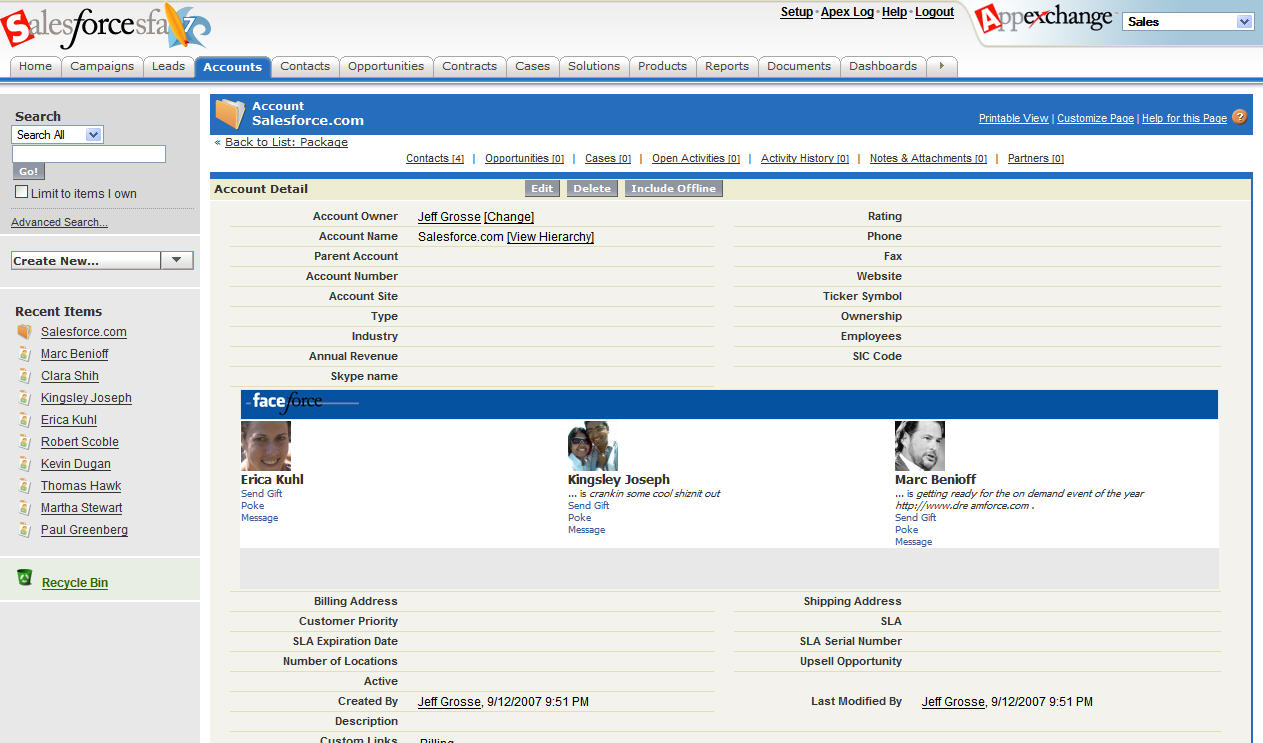
At the Account level, the S-control will display all the Facebook connections you have with that company and allow you to take numerous Facebook actions, right from the Account record.

Whenever making a cold sales call, you want as much information as possible about the contact. Given that Facebook members freely give up large amounts of personal information, this could prove extremely useful. As Jeff correctly surmises:

Yet, as a user of both platforms, you can now connect the dots, having more information at your fingertips, inline with the applications you use everyday to build deeper relationships with your customers and prospects.

For the curious, Clara has created an impressive Flash demo. A first look suggests this is one of the most powerful (by which I mean seriously useful) Facebook applications to date. The question now is whether this will become a major talking point at the upcoming Dreamforce show.

6.9.07

Traditional Marketing Practices Won't Work in an On-Demand World

The growing demand for all things "on-demand"--from our entertainment to our business information--is rapidly changing how B2B customers and prospects want to learn about your products and services.

by Joe Gustafson

On demand. Real time. Right time. Today's catchphrases are more than market hyperbole; they articulate a monumental shift in how consumers want to receive information and a wake up call for businesses to adapt or perish. For marketers in particular, this evolution means traditional information dissemination and message delivery strategies just won't work.

To succeed in today's increasingly flat marketplace, marketers need to understand how the advent of an "on-demand" mentality, has led to numerous changes in the way business professionals deliver and consume critical information. People want customized, personalized communications and they expect to receive information at their convenience. The time and place are no longer relevant to the successful delivery and consumption of marketing information. In fact, as more and more business is done away from the office, on the road and via mobile devices; paper-based, in-person, time-specific marketing information is rapidly becoming a thing of the past. To ensure your marketing activities are meeting these new demands, let's discuss the three primary drivers behind the on-demand trend and how your organization can take advantage of the industry evolution.

Attention spans are shorter in today's on demand society

Customers are exposed to an increasing amount of data and information each day - from radio to TV, blogs to web sites, instant messages to text messages. Given all this content available at their fingertips, people have less and less time to spend digesting individual sources; and less patience if it does not quickly grab their attention. In order for people to consume your messages effectively, marketers need to make it as easy and enjoyable for potential buyers to learn more.

Consider the stages of the buying process. In the early stages of the buying cycle, prospects are less "invested" in examining your offerings. It's even tougher if you are trying to uncover latent needs -- reaching those who are still as yet unaware of the benefits they could attain from your offerings and not actively out looking for solutions like yours. At this stage, prospects are rarely willing to take time out of their busy day and give it to a vendor. Reading thru reams of information, or even requesting their participation in a live one-hour webinar is asking quite a lot given busy schedules -- after all, time is money. Marketers need to make it easy for prospects to consume messages -- available when they want it and in the format which they need -- whether online or offline, during the day or after work hours.

Marketing has a greater responsibility to educate the prospect

Today, it's far too costly and risky to rely upon sales teams alone to educate the prospect. Marketing is tasked with a greater responsibility for educating buyers, and aims to deliver a consistent, compelling message to guide buyers to the next logical step -- or so they hope.

The challenge is that buyers are overwhelmed with information, and most of it looks the same -- will your brochure or your landing page really make a difference? That is, if anyone reads it?

Today's on demand communication technologies help you successfully educate prospects by delivering more compelling and measurable communications. You can get your best experts in front of your prospects at a time that is convenient for everyone -- their OWN time. It can make all the difference to secure a sale -- but it has to be scalable. Tools for experts to record their topic presentations can be as easy to use as the telephone, and this is critical to socializing this form of communications across your organization. To create the customized, timely messages that are relevant to your prospects, you can no longer take weeks of time and skilled developers to create this form of content -- it has to be easy and accessible to business people -- for marketers, product managers, CEOs and other thought leaders to play a part in delivering valuable, timely content for buyers to get to know you, your company, and the value you provide.

Marketers face growing pressure to demonstrate ROI

The recent business emphasis on transparency and compliance has finally reached the marketing department. Complacency with costly and traditional long-term marketing campaigns is no longer; today marketers are under intense pressure to justify activities and demonstrate tangible ROI. Additionally, marketers are being measured not only on lead generation programs, but also how they supported the success of those leads.

For instance, on-demand lead generation tools can now identify who has viewed your message, for how long, and their corresponding level of interest. Similar sales measurement tools are also available to help identify which are being used and at what point in sales process, who is consuming messages and how they are resonating with prospects. This presents an unprecedented advantage to marketers, providing immediate feedback on marketing outreach and support. Instead of waiting weeks or months to run a campaign, gather results and analyze the data, organizations can get real-time information on how well messages are resonating, know which messages are most valued by the prospect, launch followup while interest is at its highest, and accelerate revenues.

Clearly the requirements for marketing have changed drastically. However, by understanding these market drivers and embracing the evolution of how consumers want information, you can harness the power of on-demand communications to develop more effective and more profitable marketing programs. Users want customized, personalized communications and they want it delivered on their terms -- whenever the real time or right time may be.

As a marketer, seek to provide a rich, easy to use, on-demand format that prospects will be willing and eager to experience. Deploy simple, robust tools that can quickly and easily communicate individualized messages, while providing the opportunity scale to help maximize resources and revenues. But, balance customization with high value interactions, ensuring each communication brings valid information and insight into the sales process. Finally, recognize the on-demand mentality is not just for prospects, but for your organization as well. Make measurement your mantra to address ROI metrics head on with tracking and reporting capabilities for lead generation and ongoing sales efforts. By leveraging on-demand technologies and services you can ensure your messages are delivered according to the communication mediums audiences require, maximizing your marketing results and propelling your organization to success.

29.8.07

New eBook: Top 10 Tips for Effective Landing Pages

Probably everyone has heard about some stats that are in MarketingSherpa's “Business Technology Marketing Benchmark Guide 2007-08.” Namely, that:

1. 80% of your new customers think they found you

2. And 83% of those used Google to do it.

But are you using the most effective means of converting those buyers into customers? A B2B marketer should be using this opportunity to educate the buyer. You should frame the discussion and establish your company's brand as a trusted adviser who understands the buyer's problems and knows how to solve them.

You should speak the buyer's language, using words they use as keywords in your search engine marketing and optimization campaigns. Ads that use those or similar words are more like to be clicked, and landing pages that continue the "conversation" by also using those words are more likely to result in conversions.

So, to that end, we have created an eBook as a primer to landing pages, '
Building Effective Landing Pages,' where we explain why landing pages are an important part of your online marketing campaigns and list the top ten ways to build landing pages that will increase your conversion rates.

Download Now:
Building Effective Landing Pages eBook

Salesforce Marketing at Dreamforce!

It’s been awhile since we’ve posted here but we’ve been busy this summer building tons of great new features and content to share with you at Dreamforce! We’re excited to announce that Salesforce Marketing will have 2 tracks at Dreamforce this year which will be held Sept 16-18 in San Francisco.

The first track,
Marketing I: Building the Funnel is geared towards users who are either new to Salesforce or new to certain aspects of the marketing product. We will be covering the entire range of marketing topics including lead management, search engine marketing, campaign management, email marketing, analytics and more.

The second track,
Marketing II: Advanced Strategies will be focused on just that – advanced strategies! If you’ve been using Salesforce Marketing for awhile now you might be looking to take it up a notch and that’s exactly what this track is designed for. We’ll be discussing best practices in lead scoring, integrated website tracking, search engine marketing techniques and extending beyond Salesforce reporting just to name a few. This is a track even you seasoned veterans won’t want to miss!

For more details on Dreamforce check out the conference website at
www.dreamforce.com.

Hope to see you there!

Podcast: Landing Pages Double your Conversion Rates

Jon talks with Heather Lutze of Lutze Consulting about Marketo Pay Per Click and Landing
Pages. Heather asks Jon why use landing pages, and he gave some great statistics:

- 6.3% average conversion rate for home pages

- 9.3% average conversion rate for loosely relevant landing pages

- 12% average conversion rate for highly relevant, targeted landing page

Jon talks about the Marketo Landing Pages on-demand application, which includes the ability to easily create landing page templates and pages, as well as conduct A/B testing. Marketo Landing Pages is available as a Test Drive and 30 Day Free Trial, both available at www.marketo.com.

15.8.07

Salesforce.com Dominates Australia's Software as a Service Market

Accelerates past 1,000 customers in Australia & New Zealand winning customers like Amcor, CGU, Challenger Financial Services, Fairfax Publishing, Flight Centre, Lend Lease and Smorgon Steel Frost & Sullivan confirms that salesforce.com holds approximately 50 percent share of Australia's on-demand application market in 2006MELBOURNE - salesforce.com Summer '07 Launch Event - July 16, 2007 - Salesforce.com [NYSE: CRM], the market and technology leader in on-demand business services, today announced that more than 1,000 companies in Australia are now using its on-demand CRM application suite and platform.

Growing demand for Software-as-a-Service (SaaS) - especially among the nation's enterprises - is providing salesforce.com's Australian operations with tremendous customer and subscriber growth. In addition to continued adoption among small-to-medium sized businesses, salesforce.com signed its first 1,000 subscriber customer in the region and has secured major local enterprises including Amcor Limited, BlueScope Buildings, Challenger Financial Services, CGU, Fairfax Publishing, Flight Centre, IDP, Lend Lease, SKILLED Group Limited, and Smorgon Steel in the last twelve months. "Momentum and adoption of salesforce.com's on-demand model is reaching new heights in Australia as our customers realize the success that is possible through our vision of 'No Software'," said Marc Benioff, chairman and CEO of salesforce.com. Salesforce.com was founded in San Francisco in 1999 and established its Australian operations in June 2003.

The company has pioneered the SaaS phenomenon which allows organizations to abandon traditional software delivery models and embrace enterprise class software as a service via a web browser and subscription payment model - with no software to license, install and upgrade. Demand for SaaS solutions by Australian companies of all sizes is forecasted to increase significantly. Frost & Sullivan predicts that the Australian SaaS market will experience a 40 percent compound annual growth rate (CAGR) through 2009. The company has only been in Australia for three years but according to Andrew Milroy, consulting director at Frost & Sullivan, "controlled approximately 50 percent of the market in 2006." According to ACA research, a leading market research firm and authors of The Australian SaaS Market Index[1], up to 85 percent of Australian companies are likely to consider SaaS over on-premise solutions.

"One of the most compelling findings is that as users switch to an on-demand or SaaS model, they experience measurable business benefits. Fifty eight percent of respondents using SaaS recorded significant gains in operational efficiency. Forty percent have experienced increases in revenue," said Dr. Catriona Wallace, Director, ACA Research. In contrast, respondents reported they are struggling with on-premise software maintenance. More than 40 percent of respondents spent over a quarter of their IT budget on in-house software maintenance [excluding staff costs]. Respondents also indicated they were struggling with software upgrades and staff shortages. According to Bruce Kaider, general manager, Business Development and Strategy for Western Bulldogs, "Salesforce.com requires low up-front costs and minimal new infrastructure. It can quickly and easily scale as our business grows and integrates seamlessly with our existing applications."

Grant Waldeck, Marketing Manager of Flight Centre Australia's corporate arm FCm Travel Solutions adds that the SaaS model eliminates the upgrade issues that plague traditional client-server software.

“Our business relies on e-mail connectivity, so it is also a huge benefit to us moving forward that we can communicate to our customers via salesforce.com for any late breaking news in our industry that may be effecting their travelers". We know it’s in safe hands and that we’r e getting the very latest tools,” he said.